|
ARTVOCADO RUNEN*
* Rune:
1. a character in any of several ancient Germanic alphabets used from about the 3rd to the 13th centuries. The earliest Anglo-Saxon texts and inscriptions were written in runes .
2. a mysterious symbol, inscription, or incantation, especially one believed to have magical power
3. a Finnish poem or stanza
Encarta® World English Dictionary © 1999 Microsoft Corporation. All rights reserved. Developed for Microsoft by Bloomsbury Publishing Plc.
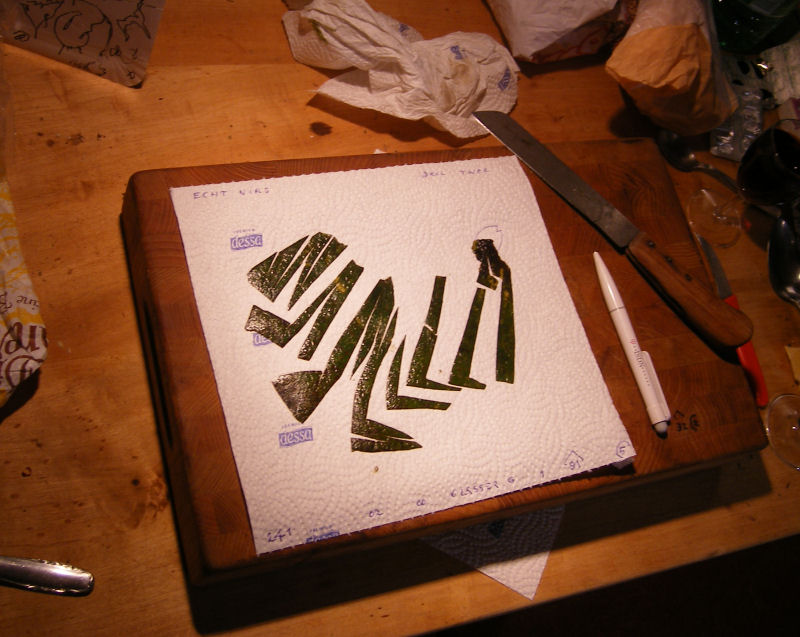
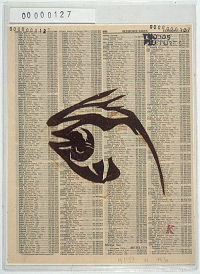
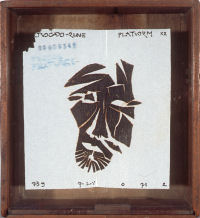
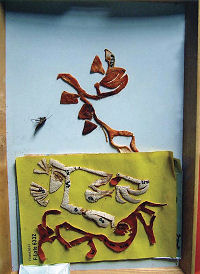
Around 1993* Jacobus Kloppenburg starts with the FLAT-FORM studies with peelings of fruit; The fruit, after being experienced by hand as volume and cosmic space/form/language and platonic sound, as weight and ‘pure’ nature, is than peeled and the fruit eaten. In the case of avocado, the peel is cut in two sections, the flesh removed and the peel cleaned with a sharpened spoon. The peel of the fruit form is treated by incisions with a small knife and pressed. The pressing can cause unforeseen/unknown form development, mysterious symbols. The flattened peel is put under a weight to dry. The resulting flattened picture with a spatial origin, the fruit, becomes 3D FLAT-FORM, an extract of multiple dimensions. Melons, oranges, mandarins and bananas are 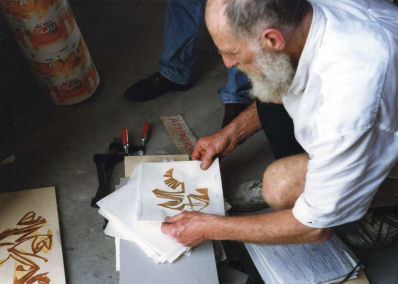 processed in this manner. The avocado is the preferred choice, because of its taste and nutritional value, and because of its pear shape, concave and convex. Thus a large series of AVOCADO RUNEN or ARTVOCADO RUNEN is created. (but footballs were also peeled, mathematically unfolded and rolled out. See FIUWAC 258). Runen refers to the unforeseen coincidence that causes spontaneous development of forms during the flattening process of incised peels, and the mystery of meaning of the resultant shapes, a strange sort of alphabet, space language, sound. The linguistic flat-forms are part of a complex platonic and esoteric manuscript. processed in this manner. The avocado is the preferred choice, because of its taste and nutritional value, and because of its pear shape, concave and convex. Thus a large series of AVOCADO RUNEN or ARTVOCADO RUNEN is created. (but footballs were also peeled, mathematically unfolded and rolled out. See FIUWAC 258). Runen refers to the unforeseen coincidence that causes spontaneous development of forms during the flattening process of incised peels, and the mystery of meaning of the resultant shapes, a strange sort of alphabet, space language, sound. The linguistic flat-forms are part of a complex platonic and esoteric manuscript.
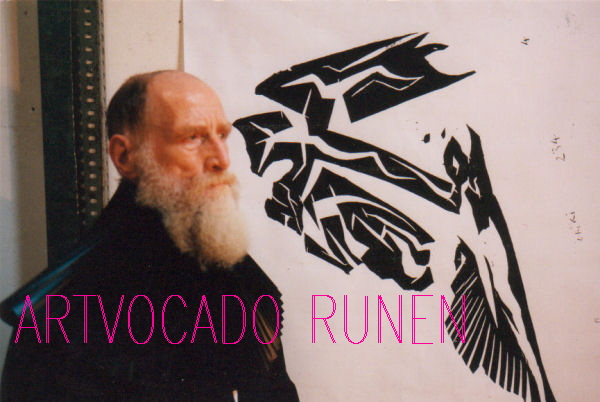
In November 2003, WENG LING, Director of the Academy for Traditional Art, Beijing, paid a work visit to Waldo Bien, FlU Amsterdam, together with WEI HONG, Houston, FIUWAC artist. Hundreds of ARTVOCADO RUNEN at that moment lay orderly spread out on the floor in the atelier, like a huge manuscript, ready to be photographed by Bien. The specialists from China immediately go up to have a look, they bend over the works and watch them in silence for a long time. Then Weng Ling says; "Tell me, what language?" Kloppenburg replies: "For me, that question is the greatest compliment imaginable."
A construction error, made during the renovation of studio Lauriergracht 111, causes the kitchen to flood whenever it is raining. 91 ARTVOCADORUNEN, laid to dry under the weight of pavement tiles, are lost. Kloppenburg pities most of all that no copies had been made of them yet. This causes a serious gap in his morphological research. To avoid further losses, 64 of the remaining ARTVOCADORUNEN are moved to the collection of Museum Schloss Moyland, where at that time Franz Joseph v.d. Grinten is the Director. As an artist and critic he qualifies the 3D ARTVOCADO FLATFORMS on arrival as "Künstlerische Hochleistung". Another series goes to WaIter Hopps in Houston, TX, to Triodos Bank and to the FIUWAC.
This sequence is still in progress. All material at the FIU archive is currently registered and under research.
The conceptual transformation, shift of dimensions and reference can be followed by the artist’s own naming: The listed titles/quotations are taken from individual, registered sheets. (W.B. archief, FIU Amsterdam)
Galleries with Artvocado Runen can be found in the upper-right corner of this page.
* Note: The exact date of the beginning cannot be given since important research material is kept hostage by the city of Amsterdam and locked up in containers since October 1997. (see AFAIR)
|