|
SKETCHBOOK JOURNALS The earliest surviving sketchbook; now located at the FIU Amsterdam archive, (see Book pages 26/27), dates from the beginning of the fear loaded WW2 period, 1940/41. Holland at war with Germany, Amsterdam occupied, holocaust. The young artist , than eleven years old, dates several drawings that were possibly made in the school bank (as a surviving photo suggests) or at home at the kitchen table, at Lauriergracht 106, (dated: JK 25-9-41, another 29-10-41) Date and Timeframe: 1967-1969: K starts consistently to give an exact date and time, down to the minute, of his drawings. This creates a legible and re-readable script where his developments can be studied afterwards, but, for him, it also affords information on how long things have taken. He shares with the oriental masters of calligraphy a concern for the rapidity and the virtuoso quality of the gesture, a view that a minimal impact is of great importance. It is a mark of Kloppenburg's sense of the economical not to spend more time on anything than is absolutely essential, but, equally, that can also be a very long time. K sets the bar very high for his working standards. For similar reasons of economy he often draws on both sides of the paper, sometimes turning the paper round in a random way, which makes it both necessary and possible to read the drawings from multiple directions. Economy definition: A sheet is 'full' in the sense that is dictated by its level of saturation. His credo is, do within the available space and with minimal means as much as the space and your concept allow, without collapsing. The scale of balance that K maintains can range from crammed to almost empty. Sometimes there are several lines, and sometimes just a crease, or, a cut in a piece of paper is enough.
Topographic Codes: L (Lauriergracht), N (Neubrückstrasse), M (Merowingerstrasse), T (Ternaard). Because of pragmatic reasons, from that time on K no longer works on separate pieces of paper but preferably on 'noteblocs', A4, A3, cash register books etc. As a result the geometrical and the free drawing iconography from the former years, now come together within the connected unity of the note bloc and flow over into each other. Paper: The paper which is used preferably has a certain transparency which allows the drawings to be seen in optical connection to each other, something artists usually try to avoid. As such it also becomes possible to include elements of a previous drawing into a new one and so to be further developed. Sometimes this logic is also intentionally reversed, for example by skipping a dozen pages and then working backwards. Only the noted exact date and time give closer insight into this complicated and intentionally confusing game. On his own account, he does not mention the game of confusion, the blending of opposite categories. It is after all not produced as a consumer article. But when the spectator himself discovers something and informs about it, immediately all the rules of the game are explained in detail with great pleasure. Pencil Medium: Also the use of the pencil changes dramatically; in the geometrical drawings it is used for drawing constant and steady lines. Here, the pressure applied on the pencil remains constant. It is a different case in the 'free' drawings however. The drawings in pen were more or less constant, a characteristic of the pens used (although one can see attempts to manipulate this). But with a suitable pencil, K prefers PENTEL and PAPERMATE propelling pencils hb, it is possible through subtle differences in pressure, to draw a pulsating line which, so to speak, lashes through and in space as a whip. The drawing pencil in fact has to be an extremely subtle instrument which can be operated with minimal energy in the hand of a human being 'virtually' asleep. The drawing is thought as 3-dimensional, as linear sculpture in space, as logos and universe. The sketchbooks can easily be brought along on the constant journeys between Amsterdam, Düsseldorf and Friesland, so that the Lorelei Express train compartment also becomes atelier, production site, photo studio, coulisse and dining room. Textual Notes: The notes and texts in the sketchbook journal now become multilingual; Dutch, German, English. Important notes and suggestions are hidden within, especially in reference with the thinking of Rudolf Steiner and concerning the sculptural developments that are taking place in the Artchive for the Future. The creation of an full textual index of the remaining material is a FIU Key research project and a significant example for FIU interdisciplinary research and basis for the VUVA, the Virtual University for artists and scholars.
|
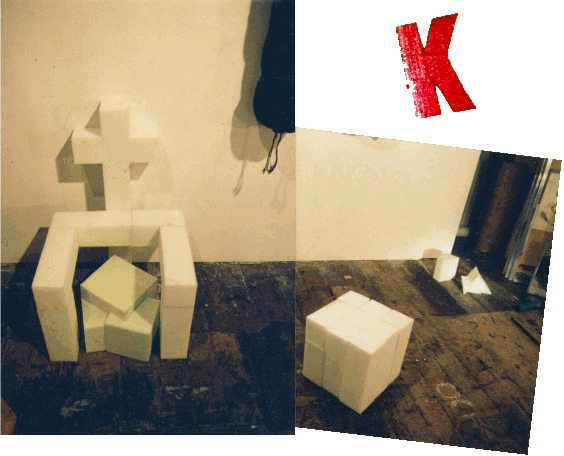 Sketchbook/journals: Working on bound paper like sketch books, office note blocks etc. is the result of Jacobus Kloppenburg’s marriage in1970 with Eva Arnscheidt, daughter of Prof. Kurt Arnscheidt at the Düsseldorf academy where Joseph Beuys also teaches. As a consequence K now starts living/working in multiple places simultaneously and thus, apart from the exact date, hour and minute of creation, now also adds the coded place of creation to his work: